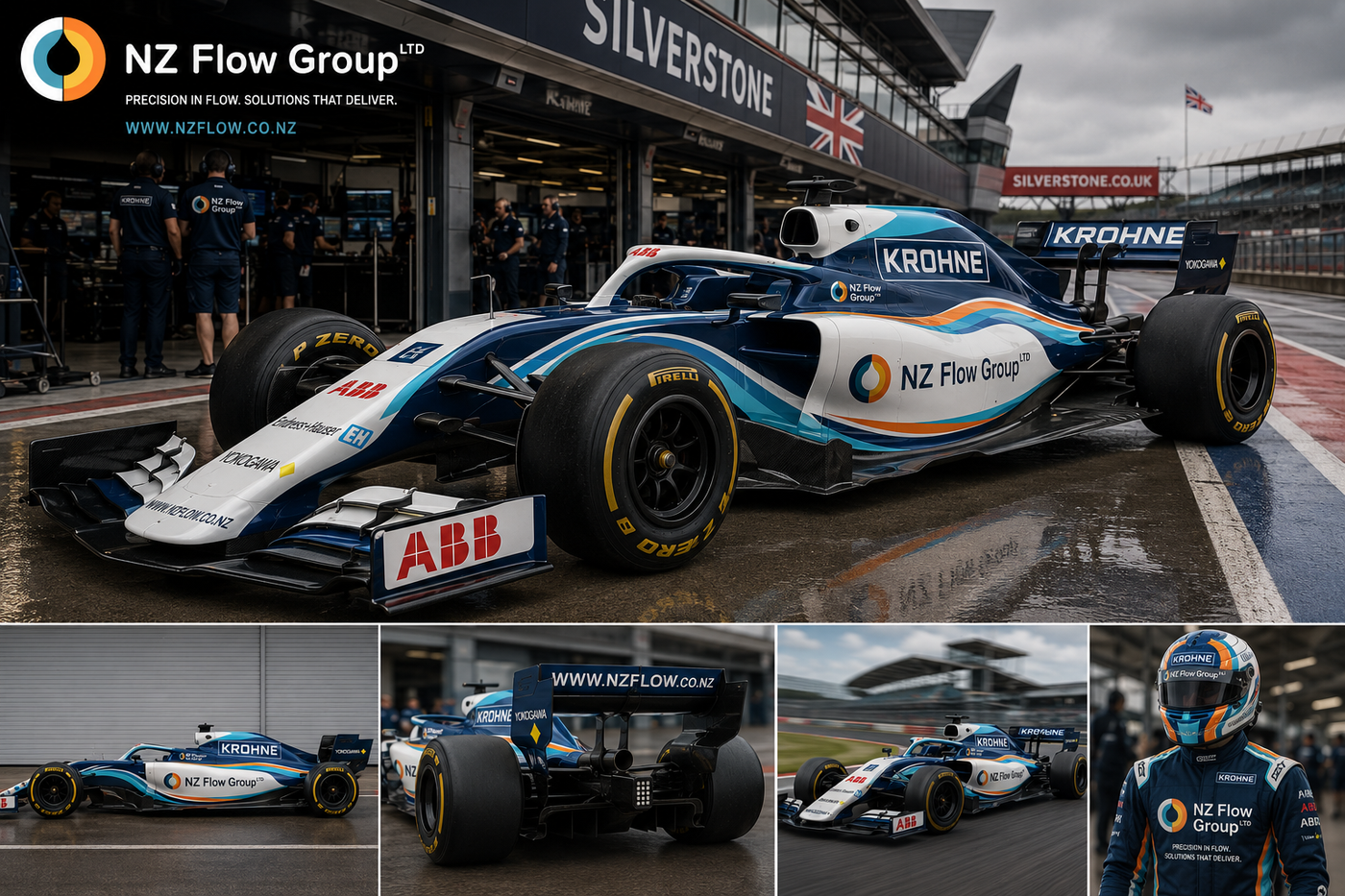
Concept image only. This is not a real NZ Flow Group vehicle, team, or sponsorship.
It's British Grand Prix weekend at Silverstone, and for the first time since 2021 it's a Sprint format, with the Sprint run today and the main race tomorrow. Five British drivers are on the grid this year: Lewis Hamilton, George Russell, Lando Norris, Oliver Bearman, and rookie Arvid Lindblad, making his debut at his home race. Since we spend our working life thinking about telemetry, we couldn't resist a look at how F1 does it, and how it stacks up against what sits on your point of take.
The numbers are genuinely wild
A modern F1 car carries around 300 sensors. Between them, they generate roughly 1.1 million data points every single second, streamed live from the car to the pit wall as it's happening. Some individual sensors, the ones tracking vibration, sample up to 200,000 times a second, far faster than any engineer could react to directly. Across a single race weekend, one car can produce well over a terabyte of data.
Silverstone adds its own bit of trivia to the weekend. It's one of only three circuits on the F1 calendar, alongside Spa and Monaco, where the corners have names instead of numbers. Maggotts, Becketts, Copse, and Stowe have been part of the circuit's identity since it hosted the very first F1 World Championship race back in 1950.
Same idea, very different stakes
Strip away the scale and the two systems are built on exactly the same idea. A sensor at the source measures something in real time, that data gets transmitted wirelessly to somewhere it can be read, and someone uses it to make a decision. F1 does that with 300 sensors and a pit-wall radio link to shave tenths of a second off a lap. Our telemetry does it with a flow meter and NBIoT connectivity, reporting in 15-minute intervals to show a consented water take is within its limits.
Different question, different timescale, same underlying principle. A pit engineer deciding whether to pit for fresh tyres this lap and a consent holder confirming their 5 L/s take is compliant for the season are both trusting a sensor they can't see to tell the truth about what's happening right now. That's the part we take seriously, whether it's worth a championship point or a compliance report.
Enjoy the race today, and if Silverstone gets you thinking about what's actually reporting data from your own point of take, we're happy to talk through it.