Nothing to do with flow meters this time. Every so often we come across a piece of technology so strange it's worth sharing just because it's genuinely true, not an urban legend, not exaggerated, just real and stranger than fiction. Here are five that hold up.
America's air traffic control still uses floppy disks
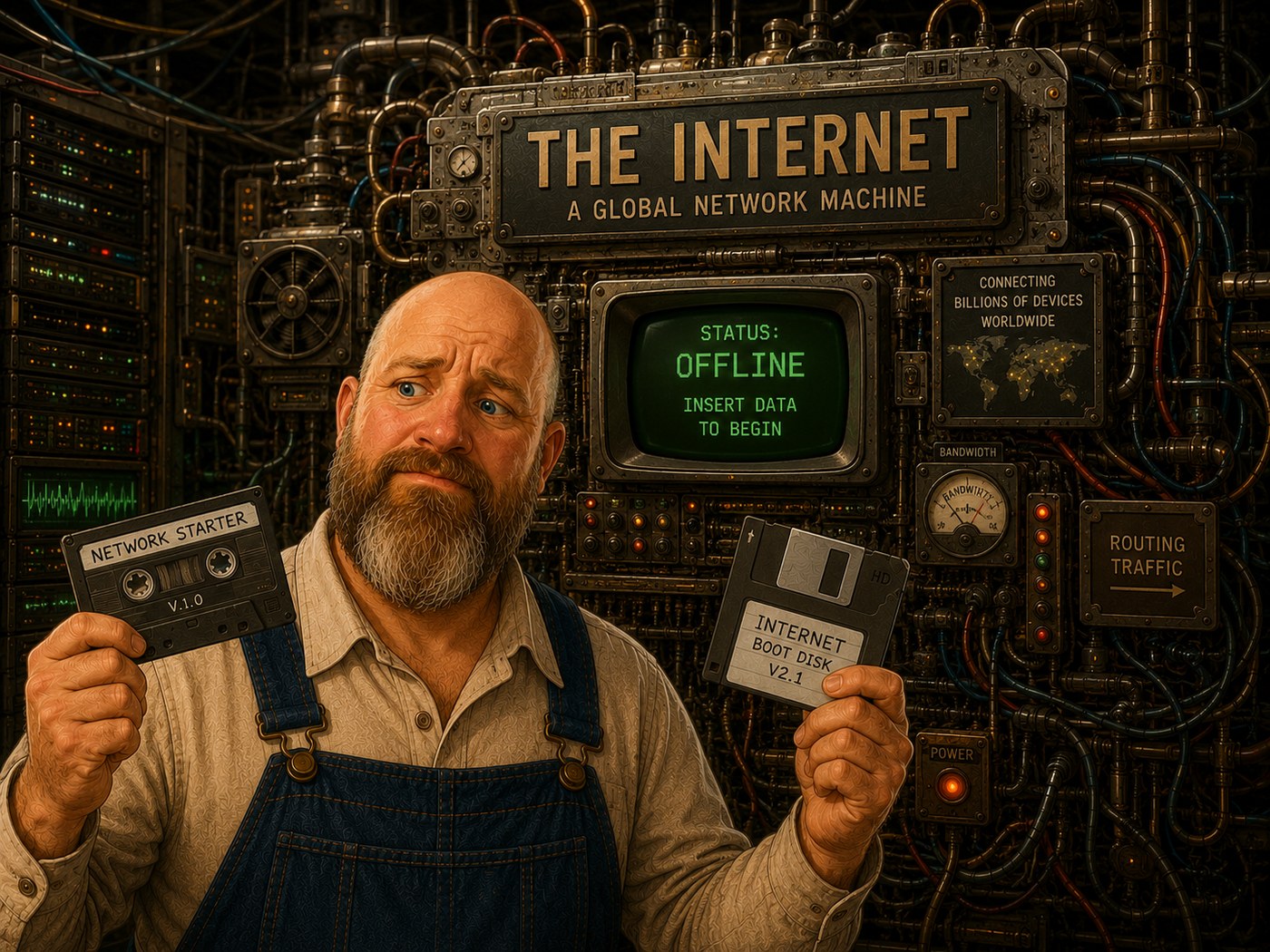
As of 2026, parts of the US air traffic control system still rely on 8-inch floppy disks, paper flight strips and equipment dating back to the 1980s. Older aircraft such as the Boeing 747-400 also continue to use floppy disks to load navigation database updates on the industry's 28-day AIRAC cycle.
The FAA has now launched a major modernisation programme to replace these aging systems after acknowledging that maintaining them has become increasingly difficult, with some replacement parts so scarce that engineers have reportedly turned to online marketplaces like eBay. Meanwhile, San Francisco's Muni Metro still starts its legacy Automatic Train Control System each morning using a 5.25-inch floppy disk, with its long-awaited replacement expected around 2033.
Your data could one day be stored in actual DNA
DNA data storage has moved well beyond theory. In March 2026, chip maker imec and Atlas Data Storage announced a partnership to help scale synthetic DNA storage toward commercial production, while research groups around the world are racing to solve the same challenge.
The appeal is extraordinary density. A single gram of DNA can theoretically store hundreds of petabytes of digital data, meaning humanity's entire digital archive could one day fit into something not much larger than a shoebox. Properly preserved, DNA can remain readable for thousands of years, far outlasting hard drives and eliminating the need for the continual media refresh cycles required by conventional archive storage.
The obstacle isn't capacity, it's speed. Writing and reading DNA is still far slower and more expensive than using disks or flash memory, which is exactly the bottleneck the latest wave of investment is trying to overcome.
Almost the entire internet runs through cables on the sea floor
Despite how it's usually pictured, hardly any of the internet actually travels by satellite. Somewhere between 95 and 99 percent of intercontinental internet traffic, an email to another continent, a video call overseas, moves through fibre-optic cables lying on the ocean floor, some no thicker than a garden hose. There are well over 1.3 million kilometres of these cables in service worldwide, more than three times the distance from the Earth to the Moon. Satellites carry the leftover fraction, useful for remote or maritime areas, but nowhere near competitive with cables on cost or capacity. The caveat worth knowing: this figure is specifically about traffic that crosses an ocean. Most of what any one person does online, loading a page, streaming a show, never leaves land at all.
The "cloud" still relies on magnetic tape
Despite the marketing, the biggest cloud providers, including Google, Amazon, Microsoft, and IBM, still use magnetic tape for long-term archival storage. While most day-to-day cloud services run on SSDs and hard drives, cold data is often stored on tape because it's dramatically cheaper than disk, consumes virtually no power while sitting idle, and can remain reliable for 30 years or more when properly stored.
Modern enterprise tape is far removed from an old cassette, but it uses the same underlying magnetic recording principle. Today's cartridges typically store around 18 to 20 terabytes of uncompressed data, and robotic tape libraries can scale to hundreds of petabytes. That's why archive services such as Amazon Glacier and Microsoft Azure Archive are widely believed to rely significantly on tape behind the scenes, for rarely accessed data, it's still one of the most economical storage technologies ever developed.
There's a working data centre on the sea floor right now
Microsoft spent nearly a decade testing underwater data centres through Project Natick, sinking shipping-container-sized server pods off Scotland and California. The results were impressive: the submerged servers failed at roughly one-eighth the rate of an equivalent land-based control group, thanks to stable temperatures, a sealed nitrogen atmosphere, no humidity and minimal human interference.
Despite the success, Microsoft has not commercialised the concept. One of the biggest remaining challenges is servicing hardware that's sitting on the seabed.
China has continued developing the idea. Since 2023, a commercial underwater data centre has been operating off Hainan Island, using the surrounding seawater for cooling instead of energy-intensive air conditioning while supporting high-performance computing workloads.
Sometimes the most interesting technology isn't the newest invention, it's an unconventional idea that turns out to solve an old problem remarkably well.