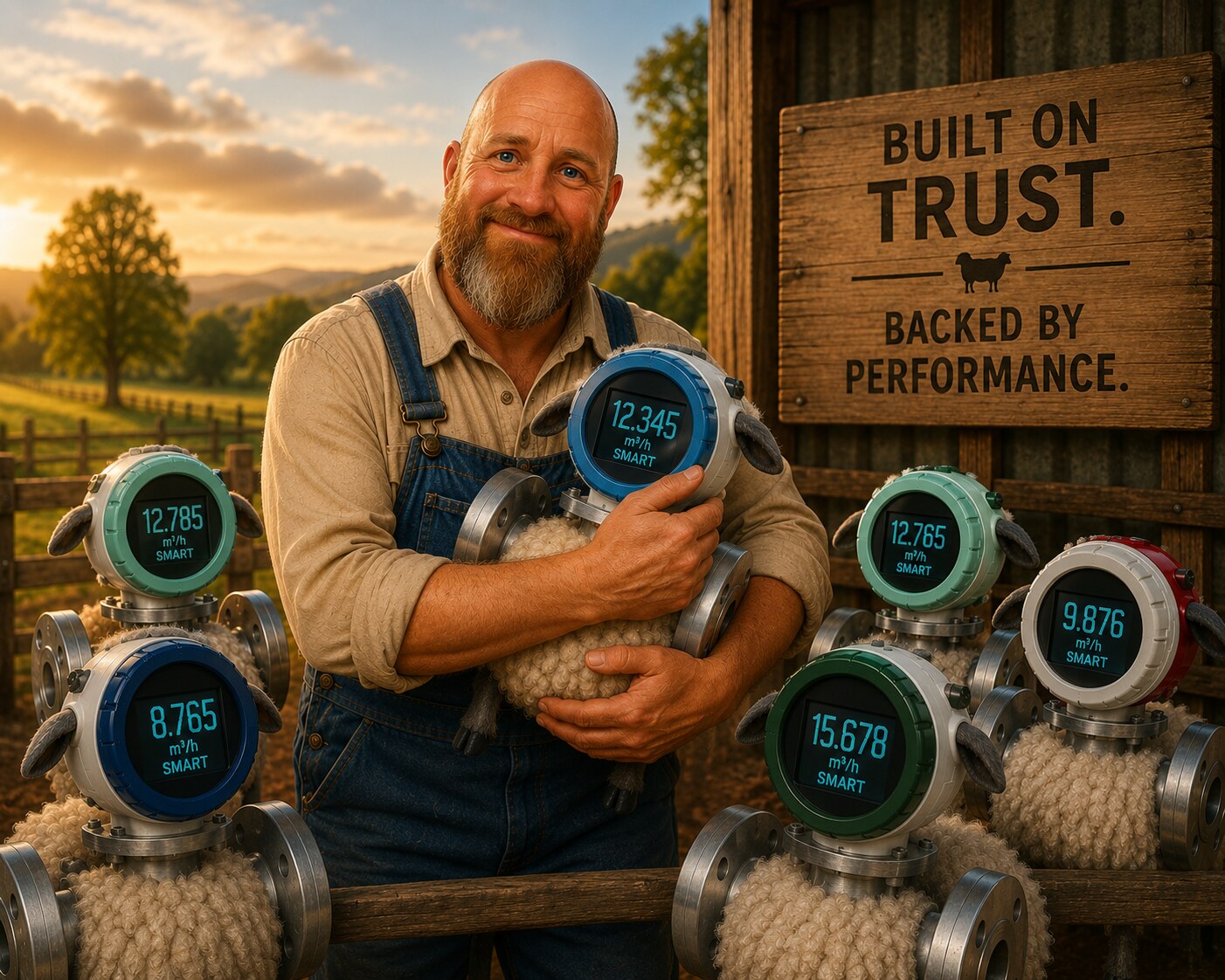
Every day we hand over trust without thinking about it. We trust the mechanic actually checked the brakes, the till charged what the shelf said, the agency publishing the official numbers didn't fudge them. Water metering asks for exactly the same leap of faith, except what shows up on that little screen might set your council rates, decide whether you're in breach of a resource consent, or feed into decisions about the water coming out of your own tap.
A reading is not the same as a fact
A flow meter doesn't just produce a number, it starts a chain. A sensor measures something physical, a logger records it, a network carries it somewhere, and somebody, or something, acts on it. That somewhere might be an internal spreadsheet, a third party telemetry provider, or straight through to a regional council or water authority. Whether that final figure can be trusted has very little to do with the meter's spec sheet and everything to do with how well every link in that chain has been looked after.
Can you trust what a flow meter is displaying and sending onward? Usually. But usually isn't good enough when the number decides a compliance outcome or a water bill. The honest answer is that trust has to be built into the whole system, not assumed just because a screen is showing digits.
Where trust actually breaks down
It's rarely the electronics telling a lie. More often it's something quieter: an installation detail that wasn't quite right from day one, a component ageing away unnoticed, or a verification that happened once and never again. None of these show up as an error message. They show up months later as a letter telling you there's a serious non-compliance, and by then the questions are less about the technology and more about who was supposed to be watching it.
Domestic water is about to learn this the hard way
Councils around the country are moving toward metering and charging for household water by volume, and increasingly that means smart meters rather than the mechanical dial that's sat quietly on properties for decades. For the regular person, this is a new kind of trust exercise. Most homeowners have never had to think about whether a flow meter is accurate, because nobody was billing them by the litre. That's changing, and unlike irrigation and industrial water takes, which are legally required to be verified within the first year and every five years after, domestic meters currently carry no equivalent requirement. For the average ratepayer, trust really is all you have. There's no independent check built into the system to fall back on if the number on the bill looks wrong.
The stakes go beyond the bill
Flow meter technology doesn't only decide what you owe. In municipal networks it can feed directly into decisions about treatment, allocation, and pressure management, the systems that get water to your tap in the first place. A meter that's drifted out of calibration, or a data feed that's quietly dropped out, isn't just an accounting problem. It can be a water quality and supply problem too. That's reason enough for the technology behind the number to be handled properly, not just installed and left.
Trust has to be built, not assumed
None of this means flow meters can't be trusted. It means trust has to be earned the same way it is anywhere else, through good habits kept up consistently.
For the regular person, and for a lot of consent holders too, trust really is all you have, unless you know to ask what's behind the number. Good instruments, annual maintenance and verification checks, and a service company with a record worth trusting are what turn "trust me" into something you don't have to just take on faith.
NZ Flow Group has spent over a decade installing, verifying, and maintaining flow meters across irrigation, municipal, and industrial water networks. If you want to know what's actually backing up the number on your meter, we're happy to talk it through.