It doesn't matter whether you're irrigating a farm, running a council water supply, or metering an industrial take. If you hold a water take consent in Canterbury, the obligation is the same: your flow data gets packaged into 15-minute intervals and sent to your regional council every 24 hours, 365 days a year. Not most days. Every day.
"I'm not using any water, why do I have to send zeros?"
This is one of the most common misunderstandings we come across, mostly in irrigation, but it applies just as much to municipal and industrial takes. If a pump isn't running, some people assume there's nothing to report. There is. A string of zeros is still valid data, and it's exactly what your regional council expects to see when a take genuinely isn't in use. What a council can't tell the difference between is a legitimate zero and a flow meter that has failed.
The responsibility never moves
Whether you are a local council and manage your own telemetry via SCADA, or a farmer and you pay a company to look after it, the consent holder carries full responsibility for meeting every condition on that consent. Handing the technical side to a provider doesn't hand over the accountability. If the data doesn't arrive, or it shows a breach, the letter from your regional council still has your name on it.
What actually triggers a non-compliance letter
In our experience, almost every non-compliance letter, verifications aside, traces back to one of three things:
The list of things that can cause it is longer than people expect
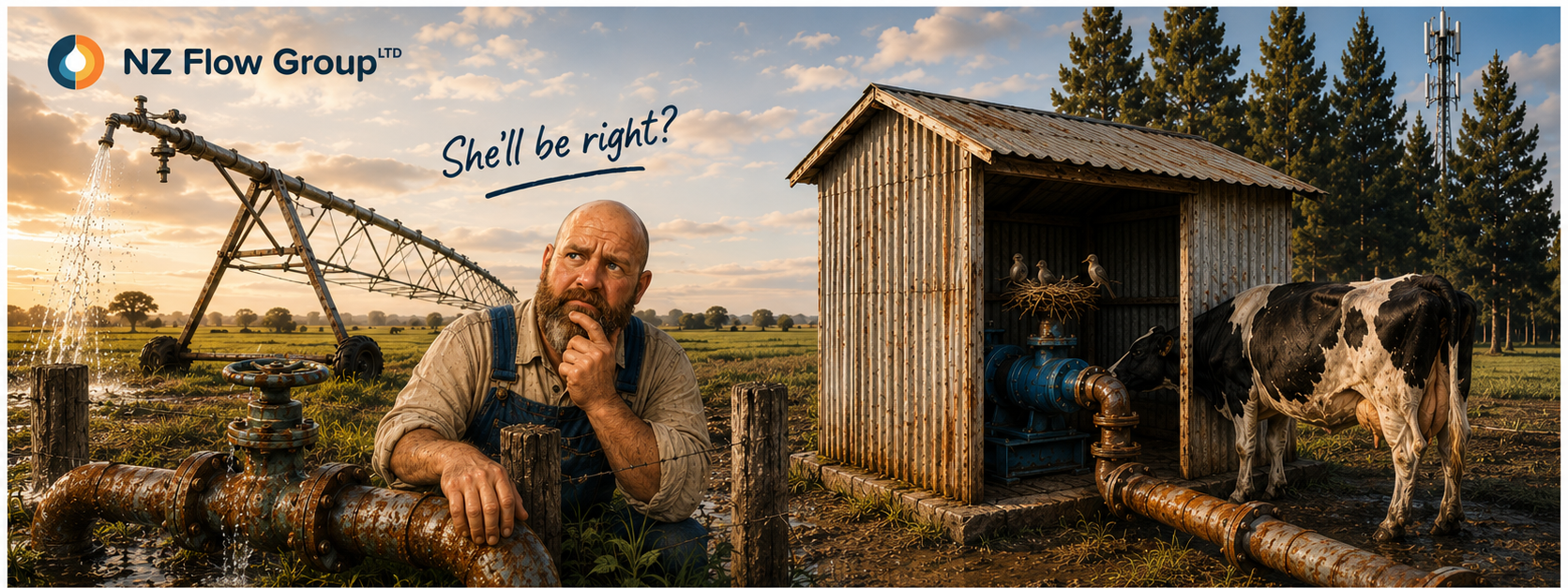
Weather and power outages account for some of it, and so do stock, machinery, or contractors not putting things back the way they found them. But a lot of the causes are quieter and easier to miss. A failed foot valve on a well riser can send a flow spike through the system the moment the pump starts. Direct online pump starters left with a fully open valve do the same thing on startup. Vermin nesting in a pump shed can interfere with pumping, measuring, and monitoring equipment all at once.
Then there's the everyday stuff: a faulty irrigator nozzle, running an irrigator longer than usual, starting up an end gun, a leak somewhere in the pipework, a manual valve that's been left in the wrong position, the first start-up of the season, a pump replaced with a bigger one than before. Add electrical noise from an unfiltered or unscreened VSD, an electric fence unit or pulse cable running parallel to a power cable, trees or scrub growing into the antenna's line of sight, water getting into an enclosure, or an electric fence wire touching pipework, and you start to see how many small, ordinary things can quietly compromise a season's worth of data.
The real question is whether anyone's watching for it
None of the above is unusual. Every site accumulates a few of these issues over time. At NZ Flow Group, we genuinely care about getting this right, and we're always looking for ways to do better for our customers, whether that's catching an issue sooner, communicating it more clearly, or simply paying closer attention than the job strictly requires. The real difference between providers is whether they're actually paying attention, particularly in irrigation, where telemetry is often treated as a box-ticking exercise rather than something that needs ongoing care. No provider, including us, is going to catch everything before it happens. But genuinely caring about your data, taking pride in getting it right, and being accountable when something slips through should never be optional. It's the baseline, not the bonus.
Next time a letter from your regional council lands in your inbox, it's worth taking stock of how your provider handled it. Did they see it coming, or did the letter tell them at the same time it told you? How did they communicate it, and did they help you fix it or just pass the letter along? As the consent holder, you're the one who decides who manages your data. One glove doesn't fit all, and there's no reason to settle for one that doesn't fit.