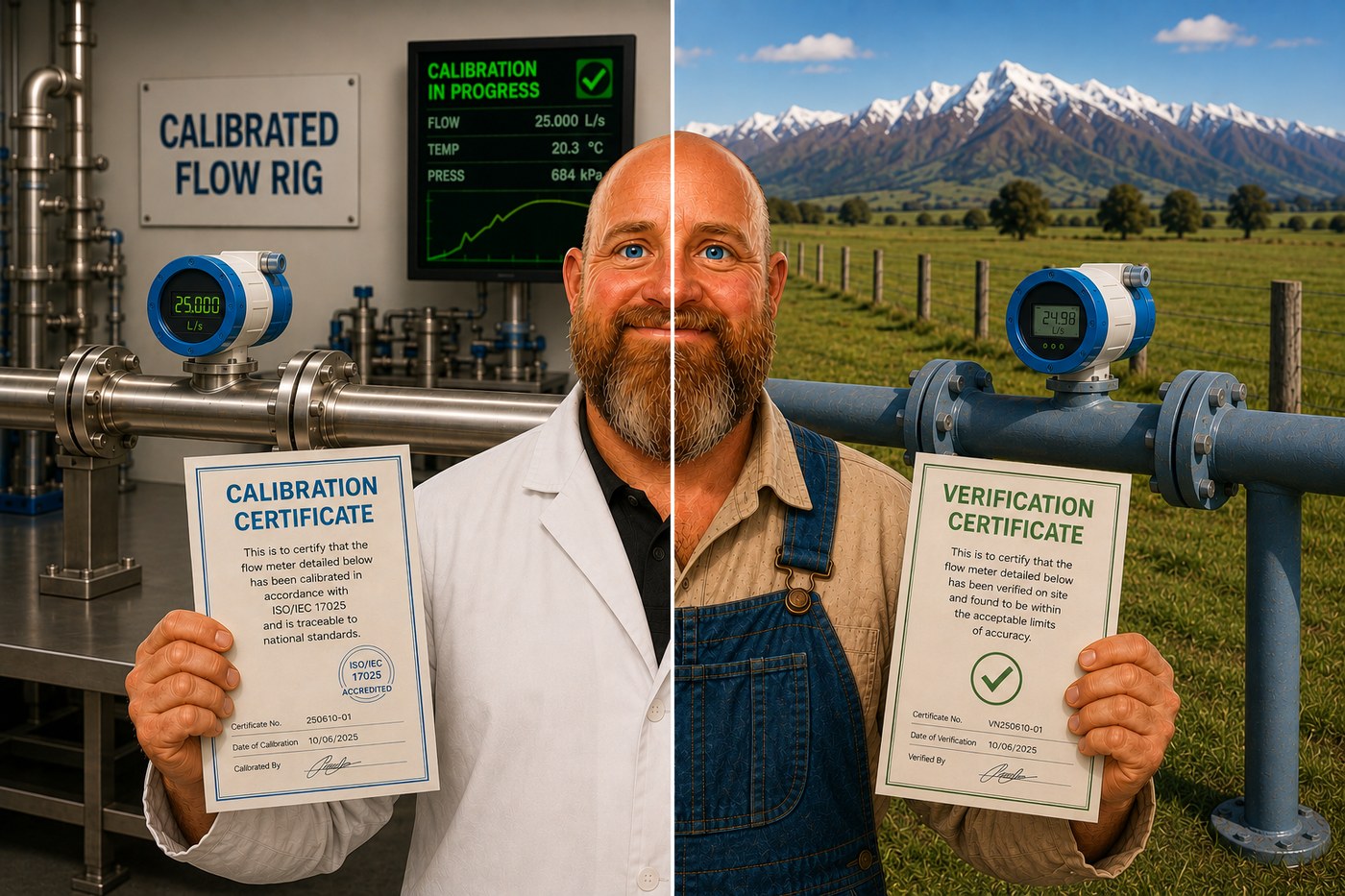
These three words get used almost interchangeably, and we hear all three thrown around for what's often the same job. They're not the same thing though, and the difference actually matters, both for understanding what a certificate is really telling you, and for knowing what to ask for in the first place.
Calibration
Calibration compares an instrument's readings against a traceable reference standard, under controlled conditions, across its measurement range, and establishes the relationship between what the instrument shows and what the reference says is actually true. If the instrument is found to be outside its required tolerance, it may then be adjusted and recalibrated to confirm its performance. This is where the word "traceable" earns its keep: a proper calibration certificate can trace that reference standard back through a chain of increasingly precise references, ultimately to a national or international metrology standard. Calibration is often carried out in an accredited laboratory where environmental conditions can be tightly controlled, although accredited on-site calibration is also possible for many instruments using portable reference standards.
Verification
Verification checks whether an instrument's readings meet a specified accuracy requirement, without necessarily adjusting anything. It answers a narrower question than calibration: not "what is this instrument's exact relationship to a reference across its whole range," but "does this instrument still perform within the tolerance it's supposed to, right now." Verification confirms whether the instrument meets a defined specification or acceptance criterion, usually carried out by comparing the installed instrument against a separate reference device that is itself calibrated. Because it's a narrower check against a known reference rather than establishing a full traceable relationship across the instrument's range, verification is well suited to being carried out on site, on an installed, in-service meter.
Validation
Validation is the broadest of the three, and the one people mix up most with verification. Where verification checks that an individual component performs to specification, validation checks that the entire system, all of it working together, actually produces the outcome it's meant to for its intended use. A flow meter can pass verification with flying colours and the overall system can still fail validation, if the installation, the telemetry, the data logging, or the reporting chain around that meter isn't actually delivering reliable, compliant data end to end. In practice, regulators and councils are often interested in validating the overall measurement process, even if the terminology used in consent conditions refers only to verification.
When you need which
If you need to know an instrument's precise relationship to a traceable standard, or you need to correct a drifting meter, that's calibration, and it generally belongs under an accredited calibration programme, whether performed in a laboratory or on site. If you need to confirm an installed meter is still reading within tolerance for an ongoing consent or bylaw requirement, that's verification, and it's exactly what most water take and trade waste consent conditions actually ask for. If you need to confirm that an entire metering and reporting setup, not just the meter, is genuinely fit for the compliance purpose it's being relied on for, that's validation, and it's the question worth asking any time a new site is commissioned or an existing one is under scrutiny.
| Calibration | Verification | Validation | |
|---|---|---|---|
| Purpose | Determine measurement error | Confirm compliance with specification | Confirm the whole system is fit for purpose |
| Adjustment? | May be followed by adjustment | No | Not necessarily |
| Traceable reference? | Yes | Usually | Often indirectly |
| Typical location | Laboratory or accredited on-site | Field or laboratory | Field/system level |
| Result | Calibration certificate | Verification cert/report | Validation report |
What NZ Flow Group actually offers
We provide verification and validation. We don't offer calibration, and that's a deliberate line rather than a gap in the service. Calibrating a flow meter against a traceable standard is typically carried out by the manufacturer or by an independent accredited calibration laboratory, using calibrated reference equipment traceable to national standards. What we do carry is an IANZ-calibrated reference instrument, the Flexim Fluxus F601, and it's that calibration chain, sitting behind our own equipment, that makes our verification results traceable and defensible in the first place.
On top of meter-level verification, we can also step back and validate the wider picture: whether your metering, telemetry, and data reporting are genuinely working together to meet your actual consent or bylaw conditions, not just whether the meter itself is reading accurately in isolation. If you're not sure which of the three you actually need, that's a good place to start the conversation.